Upcycling Polylaminates Without Separation
Waste Type:
Main Circluar Economy Strategy:
Company:
KEYWORDS
Summary
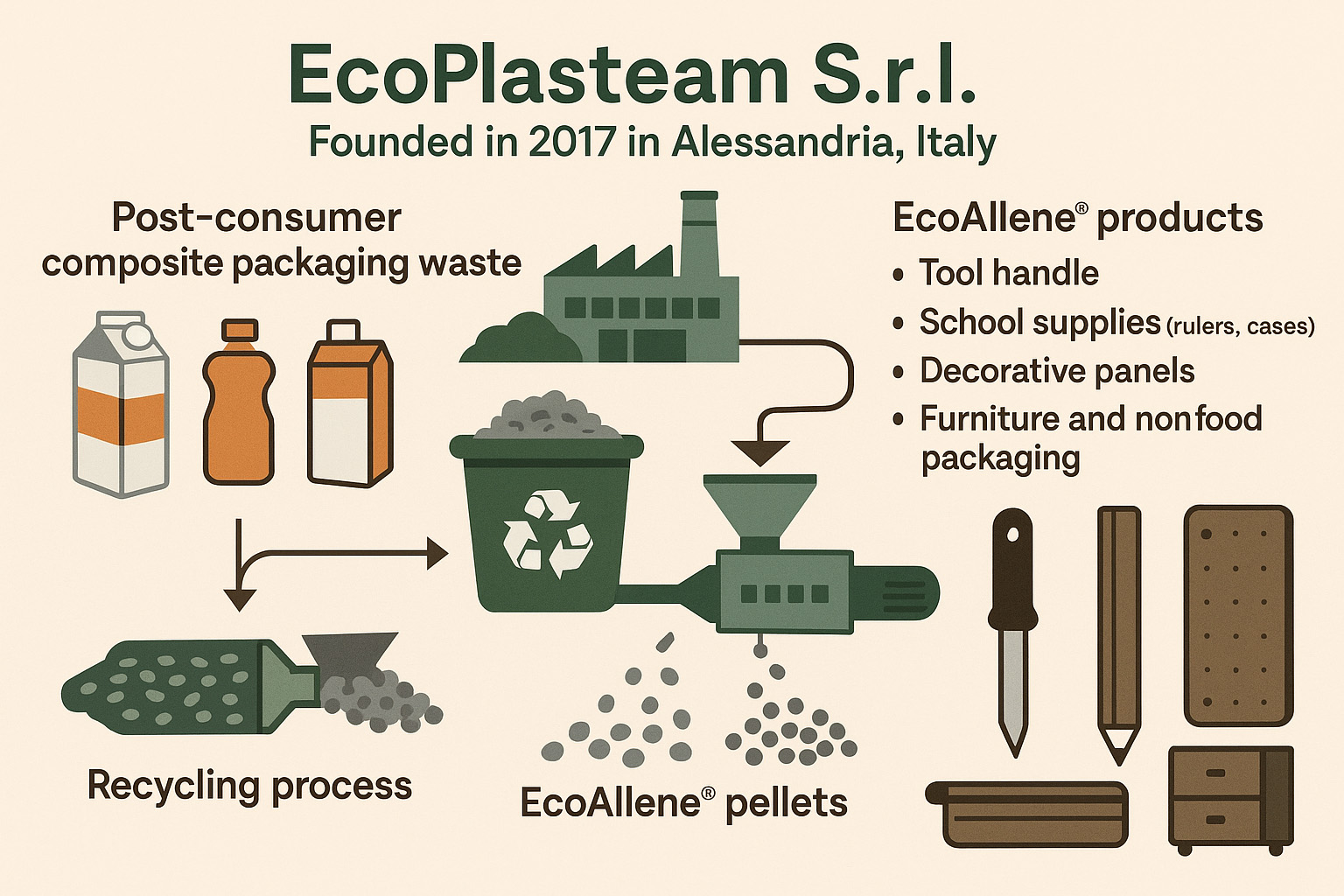
Polylaminate materials, composed of plastic and aluminum layers, are traditionally considered non-recyclable. EcoPlasteam’s mission is to transform this complex waste stream into a new marketable material: EcoAllene®, a secondary plastic-aluminum compound for manufacturing.The process includes:Shredding and washing the multilayer material. Melting and compounding the plastic and aluminum together using heat and pressure. Extruding into EcoAllene® pellets, a versatile thermoplastic suitable for injection molding and extrusion.
Description
EcoPlasteam S.r.l., founded in 2017 in Alessandria, Italy, is an innovative SME that specializes in recycling multi-layer composite packaging waste, particularly post-consumer beverage cartons and flexible food pouches. These polylaminate materials, composed of plastic and aluminum layers, are traditionally considered non-recyclable. EcoPlasteam’s mission is to transform this complex waste stream into a new marketable material: EcoAllene®, a secondary plastic-aluminum compound for manufacturing. EcoPlasteam’s core innovation is a patented thermomechanical process that recycles plastic-aluminum packaging waste without separating the layers: Feedstock: Post-consumer polylaminate waste, primarily used beverage cartons (after the paper fiber has been pulped), plus other aluminum-plastic waste. Process: Shredding and washing the multilayer material. Melting and compounding the plastic and aluminum together using heat and pressure. Extruding into EcoAllene® pellets, a versatile thermoplastic suitable for injection molding and extrusion. Product: EcoAllene® – a homogeneous plastic-aluminum compound used in products such as: Tool handles School supplies (rulers, cases) Decorative panels Furniture and non-food packaging No layer separation: Unlike conventional recycling that separates materials, EcoPlasteam valorizes the composite as-is, dramatically simplifying processing and reducing energy use. Collaboration: Key partnerships with Tetra Pak (as waste source and partner) and EcoRevive (logistics and scaling support) underpin the solution

Environmental Perspective
EcoPlasteam’s process unlocks a previously untapped waste stream, yielding tangible environmental benefits: Landfill & Incineration Avoidance: Diverts 14,000+ tons/year of complex packaging waste from disposal (2023 data). Reduces dependency on incineration and associated toxic emissions. Resource Conservation: Plastic and aluminum layers are recovered and reused, reducing the need for virgin plastic and bauxite/aluminum extraction. Prevents loss of valuable materials otherwise discarded as waste residue from paper recycling. Lower Carbon Footprint: EcoAllene® production uses significantly less energy than producing virgin polymers and aluminum. Cuts GHG emissions compared to both incineration and virgin material production. Local Recycling, Local Use: Reduces transport emissions by processing waste near source (e.g., at paper mills). Promotes circularity within national and regional material flows. Recyclability of Output: EcoAllene® products are recyclable again, forming a closed-loop system for composite waste. This solution directly supports EU packaging waste recycling targets and illustrates how difficult-to-recycle materials can be revalorized with novel thinking.
Economic Perspective
EcoPlasteam has proven that circular innovation can generate economic returns: -Waste as Resource: Inputs are low-cost or free (recovered post-paper pulping residue). Reduces landfill disposal fees for municipalities and waste handlers. -Revenue from Secondary Material: EcoAllene® pellets are sold as injection/extrusion-grade resin, especially for products that benefit from stiffness and visual uniqueness. Markets include construction, stationery, homeware, and furniture. -Growth and Investment: Over €5 million in investment, including EU innovation grants and private equity. Operating at full capacity by 2021, with planned expansion across Europe (e.g., co-locating with paper mills). -Industrial Collaboration: Tetra Pak partnership ensures feedstock reliability and potentially supports customer demand for recycled packaging materials. Collaboration with CONAI/Corepla improves feedstock collection in Italy. -Job Creation and Value Chain Impact: EcoPlasteam supports green jobs in recycling, materials processing, and product manufacturing. A projected 300,000 t/year recycling capacity in Europe could generate a new industrial segment for circular plastics. In short, EcoPlasteam turns a problematic waste stream into valuable economic output, helping bridge the market gap for circular polymers.